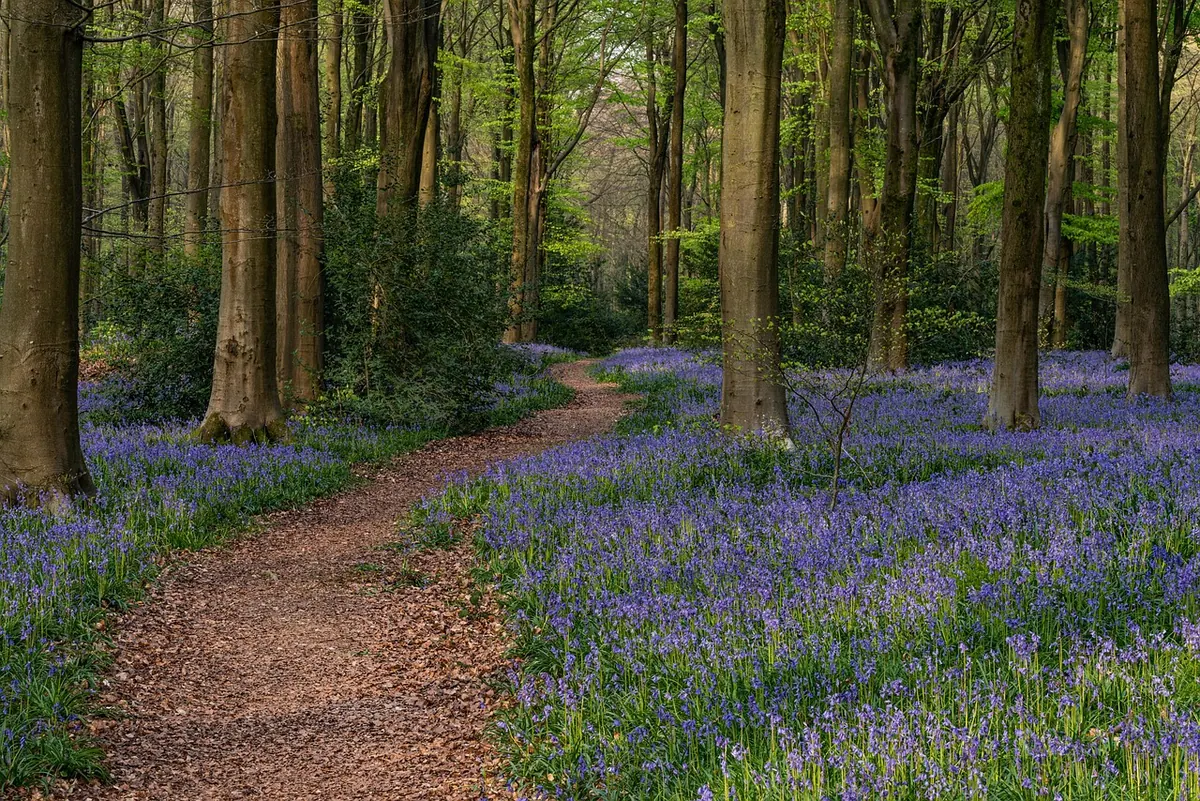
There is a fortnight each spring when the woods around the Quarter change colour almost overnight. One week the floor is last year's brown; the next it is violet as far back as you can see, and the air smells faintly sweet and damp at once. Bluebells are particular plants. A colony takes a long time to establish, and a single busy afternoon of trampling can set one back for years. So the good visits are the planned ones. What follows is when to go, the places most likely to reward the walk, what the older stories say about the flowers, and how to move through a wood without leaving a mark.
When the Bluebells Come
In a typical year the first flowers open in mid to late April on warm, sheltered banks, and the peak lands somewhere in the first half of May. A cold spring pushes everything back a week or more. A mild, dry April brings it forward, but it also shortens the show: heat burns the display off quickly, and a wood that was at its best on a Sunday can look tired by the following weekend.
Aspect matters as much as the calendar. A south-facing hedge bank may be in full flower while a north-facing slope two fields away is still in bud, so if you arrive somewhere and find green leaves, walk on and try the other side of the valley. Leaves always come first — long, narrow and glossy — and the blue arrives over seven to ten days before fading fast.
Time of day is worth planning around. Early morning and the hour before dusk give you the strongest scent and the softest light. For photographs, an overcast day beats sunshine: strong sun blows out the blue and turns the wood into a patchwork of hard shadows. A light rain shower, honestly, is better still.
Telling Native Bluebells From the Spanish Ones
The bluebells that belong here are Hyacinthoides non-scripta, and they look and behave differently from the garden bulbs that escape into the countryside.
- Native: deep violet-blue, flowers hanging mostly on one side of the stem, tips curled back, creamy white pollen, a strong sweet scent, narrow strap-like leaves.
- Spanish: paler blue, pink or white, flowers arranged all round an upright stem, blue pollen, little or no scent, broader leaves.
- Hybrids: common, and often somewhere in between. Scent and pollen colour are the most useful clues when a clump looks ambiguous.
This matters because native bluebells cross readily with garden varieties, and the resulting hybrids are now widespread. The practical rule is simple: never plant Spanish bluebells near a wood or hedge, and never tip garden waste over a hedge into woodland. A dumped bucket of bulbs can change a colony for good.
Best Local Spots and How to Reach Them
Bluebells follow old ground. They turn up in ancient woodland, on old hedge banks, along sunken lanes and in churchyard corners — places that have been wooded or undisturbed for a very long time. Look for those features and you will usually find flowers.
- The beech hanger above the mill race. Deep leaf litter, dappled shade and a slope that holds moisture. Approach from the lower path and walk up; the blue builds as you climb.
- The old railway cutting on the eastern edge. Steep banks, shelter and no ploughing for a century. Wear boots — the clay here holds water well into May.
- The lane past the allotments. Not a wood at all, but the hedge banks are some of the oldest locally, and bluebells in a hedge bank are a good sign of long-established ground.
- The copse behind the churchyard. Small, quiet and easy to miss. Stay on the mown paths, and give funerals and visitors the space they need.
- The damp hollow where the stream bends. The most reliable spot in a dry spring, because the ground stays cool. Muddy after rain, lovely in the last hour of light.
If you don't know these places yet, they are all a short walk from the centre — and the same logic applies anywhere: shade, old ground, and a slope that stays damp.
Folklore: Fairy Bells and Unlucky Pickers
Bluebells have collected more stories than almost any other wildflower here. The usual telling is that they were not flowers at all but bells, and that ringing them called the fairies — which is why children were warned off picking them, and why a picked bunch was said to bring bad luck into the house. In some versions the unlucky picker was the one who wandered; in others it was simply the flower itself, taken indoors against its will.
Pick a bluebell and you take a bell out of the wood — and something in the wood may come looking for it.
There are practical threads in the folklore too. The sticky sap was used to fix feathers to arrow shafts and to bind small books, and the bulbs were once dug in quantity for gardens — a trade that stripped whole woods and is part of the reason the plant is protected today. The stories are worth knowing. So is the fact that the modern reason not to pick them happens to look a lot like the old one: what you take out of the wood doesn't come back.
Walking Well: Routes, Rules and Practical Sense
A gentle loop for a spring morning
- Start at the lane past the allotments and follow the hedge bank north.
- Turn onto the lower path at the mill race and climb the hanger slowly — this is the best display.
- Cross at the top gate and drop down to the damp hollow where the stream bends.
- Return along the field edge to the churchyard copse, then back to the lane.
Allow two hours if you want to stop. The loop is short but uneven underfoot, and there are a couple of stiles, so it isn't a pushchair route.
What to do while you're there
- Stay on the path. Bluebell leaves do the whole year's work in a few weeks. Crushed leaves mean a weaker bulb next spring, and the damage isn't obvious until it's done.
- Photograph from the edge. Lying down in a display flattens more than you think. A low angle from the path works just as well.
- Keep dogs close, and on a lead near stock and nesting birds. If you're walking alone in remote woods, tell someone your route and roughly when you'll be back.
- Take everything home with you, including fruit peelings and picnic scraps, which draw in animals that disturb the ground.
- Never dig bulbs or lift plants, however tempting a clump looks for the garden. Buy cultivated plants instead.
Practical Notes for a Good Visit
Check the weather and the ground before you set out; a wet April makes the hollow and the cutting genuinely muddy, and boots beat trainers every time. Park considerately in the lanes, don't block field gates, and respect any closures or diversions on private land. If you see a dumped pile of garden waste near woodland, report it to the local conservation group or the landowner rather than moving it yourself — that is one of the main ways garden bulbs reach wild ground.
And if the season passes you by, mark the last week of April in next year's diary now. The bluebells will keep to roughly the same schedule. It's the rest of us who tend to be late.
Photo: ebor / Pixabay